


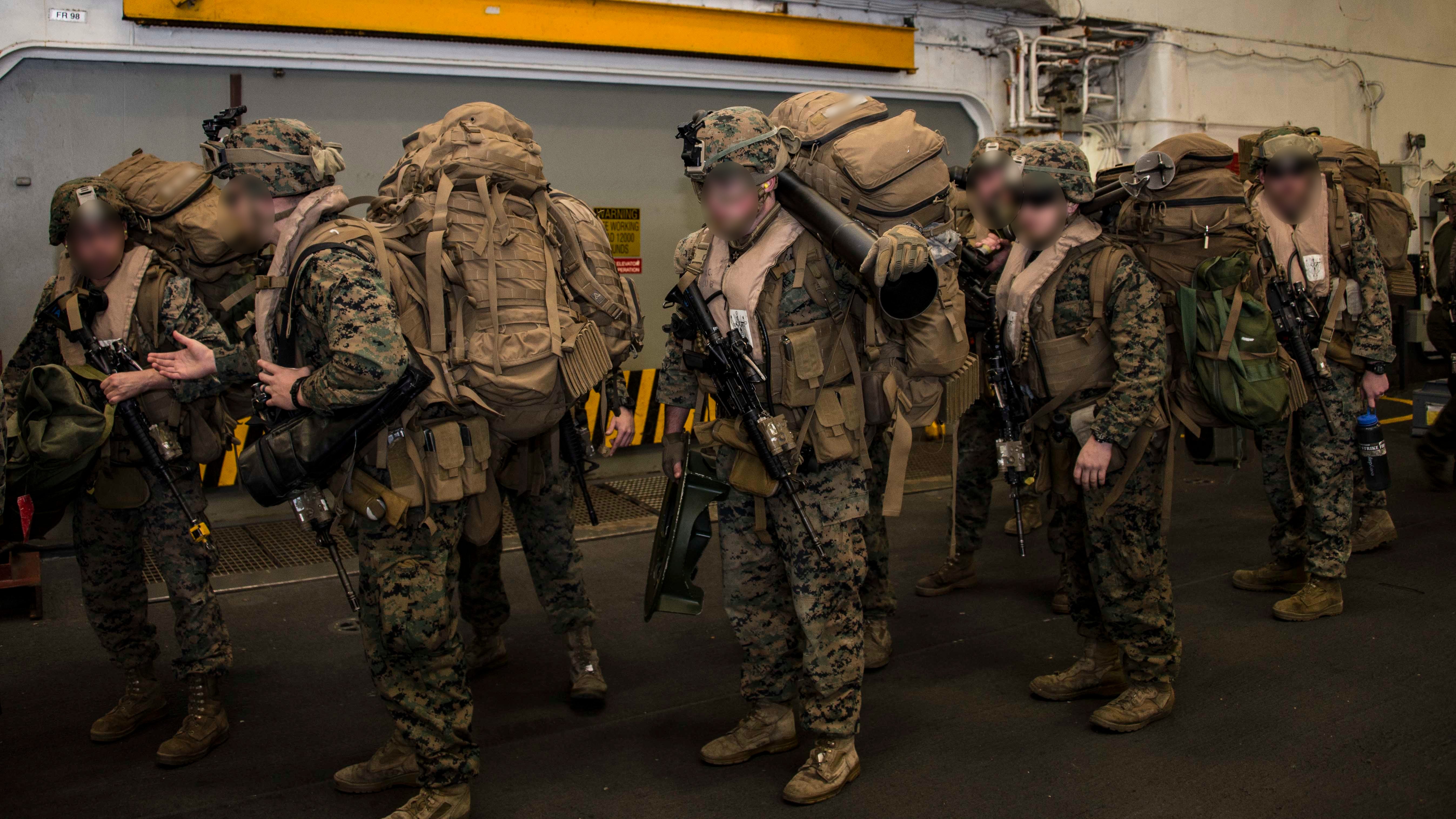
What you’re about to read is an interview with an active duty service member of the United States military. In this interview, they will give you a look inside a military organization getting ready for a potential war with Iran.
This person spoke to me on condition of complete anonymity. Their name, rank, unit, installation, branch, and area of responsibility have been deliberately withheld. Operational/classified details have been omitted. This isn’t vagueness for the sake of drama. But if the lack of details causes you to be skeptical about the information that follows, good. Be skeptical and think critically about everything you read. But there is nothing more I can give than what is to follow.
There are two people at legal risk in this exchange, and you should understand both.
For the source, speaking publicly about deployment preparations, internal morale, and changes to qualification standards could trigger an investigation under the UCMJ. Even though the source confirmed nothing they shared was classified or information they gained from a SCIF1, their career, benefits, and freedom are still on the line. And yet, they spoke anyway.
For me, as a veteran with a security clearance history, publishing certain categories of information also carries potential for consequences. Even information I didn’t originate. Even information that serves the public interest. The Espionage Act doesn’t distinguish between whistle-blowing and leaking, and the current administration has made it very clear that it values loyalty over freedom of speech. For this reason, I am not in a position to publish classified details, operational timelines, or unit identifiers. Not because I don’t think you deserve to know. But because the legal architecture of secrecy behind the cover of “national security” is designed to punish exactly this kind of reporting, and I’m not interested in finding out how far they will go.
So what you’ll get here is the shape of the thing. A firsthand account of what it looks like when the gears of war start spinning. What the people inside that machinery are thinking, saying to each other when leadership isn’t listening, and what’s being quietly gutted in the rush to fill the ranks.
None of this should have to be anonymous. The fact that it is tells you something about where we are.
What follows is the interview, edited for clarity and to remove identifying details.
Five Days
Left Face Report: Without identifying your unit, installation, or specific role, can you tell me your general career field and how long you’ve been in?
Source: I’ll say it’s a combat role. More than ten years.
Left Face Report: When did your unit first start receiving indicators that an Iran deployment was on the table? Was it before we started kinetic action against Iran? What did that look like?
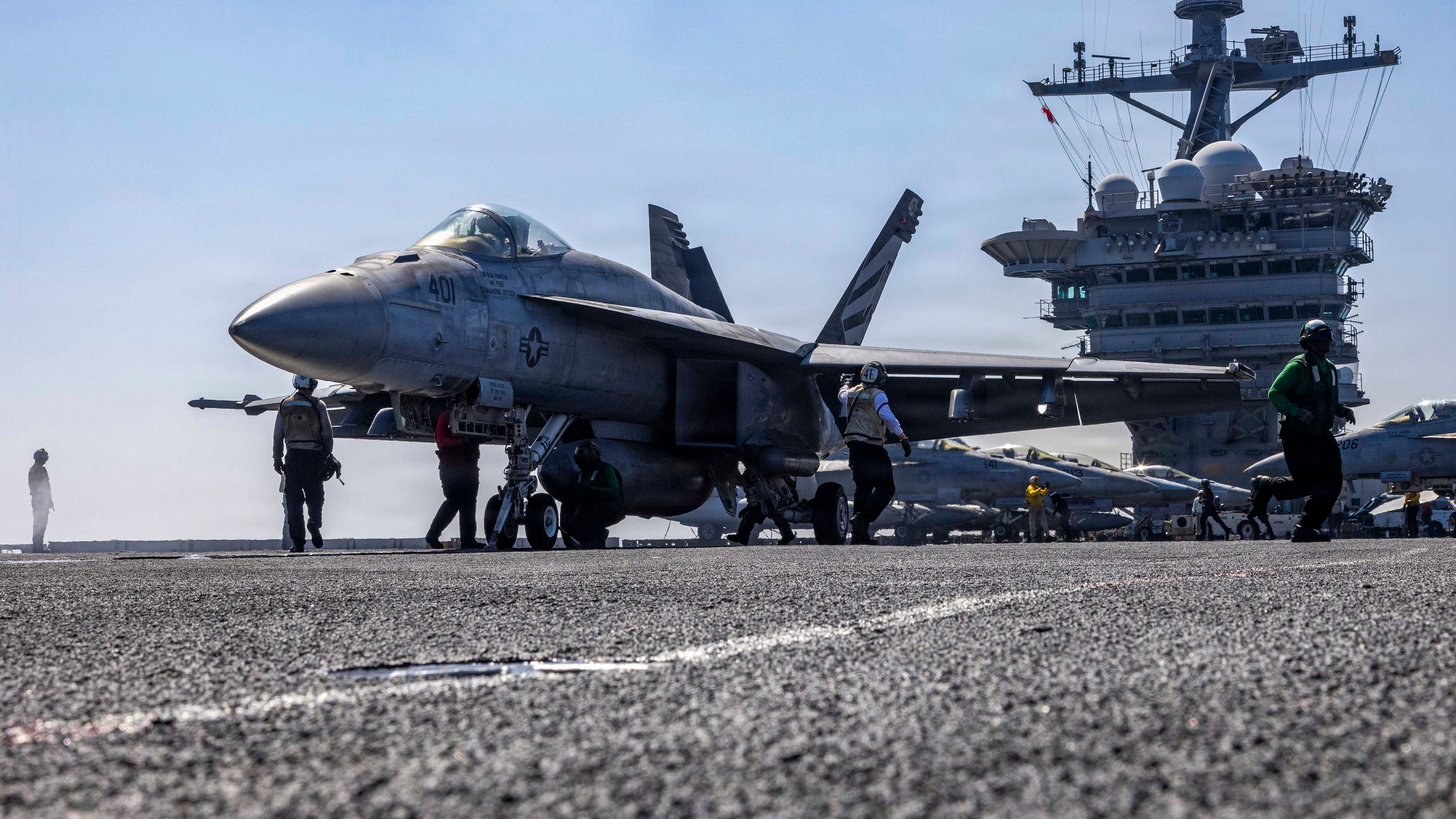
Source: It was after. After everyone had already seen it on the news. We were aware that there was a naval operation going on. Most people didn’t think we would be tagged to go since up to that point we had been focusing on a completely different region. Then kind of out of left field, one of the teams was given the order to deploy with an extremely short notice to move out.
Left Face Report: What was the unit’s reaction?
Source: Significant items on the calendar were canceled. There were some pretty important events with lots of moving parts, and they all just got canceled. This became the priority overnight.
Left Face Report: Do you know if your chain of command had been briefed about this earlier? Had there been any lead-up to the order?
Source: Leadership was blindsided.
I let the silence sit there for a moment. In my experience, there’s always some sort of warning order before such action. For even the unit commanders to be blindsided is unprecedented in my experience.
Left Face Report: Walk me through what getting ready to deploy looks like right now. What’s changed for the rest of the unit?
Source: The rest of the unit is anticipating more deployments. Our focus is being ready to deploy for future taskings as part of this conflict. The whole unit is a support system for this. No one is doing anything but either helping this team go out or getting themselves ready to be next ones to relieve them.
A Very Sudden Mobilization
Left Face Report: Has the training shifted to anything Iran-specific, or is it still generic?
Source: It’s too early to see. We haven’t really seen it yet. Those kinds of programs take a while. They take time to develop. And this is... we’ve been training for other theaters up until five days ago.
I want to stop on that sentence. Five days ago this unit was focused on entirely different theaters. The source would later describe the constant pivoting throughout the year, how priorities have shifted erratically from one scenario to the next. As this service member was about to say what the next priority was, I asked, “Mexico?” To which the source said, “No. The United States.”
Just before this switch to focus on Iran, the member was receiving briefs on what their limitations were if tagged to deploy domestically. From domestic operations to Iran in a matter of days. Trump doesn’t seem to care how many directions the troops are pulled in.
Left Face Report: Are families being briefed? What are they being told?
Source: They had all the families come in and gave an unclassified intel briefing just to let the families know what’s going on and what to expect. Had all the logistical stuff, legal, wills, and life insurance. They’ve just been condensing the stuff that we normally would do to meet the timeline.
Left Face Report: How does this compare to previous deployments you’ve been part of or witnessed in your unit?
Source: Those deployments were part of ongoing conflicts where we were aware of the cycle and knew about the deployment months in advance. This was a very sudden mobilization by comparison. You’d have months to prepare. You’d have months to do your will and get out of your lease. It’s the number one priority. The whole unit is a support system for this.
The pace, according to the source, has been disorienting for everyone. Even the young people who are enthusiastic seem to be in a daze. The unit hasn’t had a single coherent focus. Priorities have shifted constantly and erratically throughout the year. The word the source used to describe it was “frantic.”
Lowered Training Standards
This is the section of the interview I want readers to pay the closest attention to.
Left Face Report: You told me before this interview that they’ve drastically reduced qualification requirements to get people out the door. Can you be specific about what’s changed?
Source: I obviously can’t get too specific, but I can say it wasn’t explicitly marketed like it was for the deployment. But the timing is pretty coincidental. They eliminated very important requirements that I’ve never seen waived before. [pause] Ever. There are important training requirements that are being either waived or eliminated from the curriculum to get people out of the door faster.
Left Face Report: When did those changes start? Was there a directive?
Source: Very soon after the alert. And yes, it was a directive.
Left Face Report: In your professional judgment, what are the operational risks of putting people through at this reduced standard?
Source: We’re sending people to combat with less training. I mean, that has its own inherent risks. People are going to be less prepared in the interest of expediently getting them out there.
Left Face Report: I’m going to be direct. Do you expect this to result in increased friendly fire incidents and civilian casualties?
Source: Maybe not for this first batch, because these are dudes that have experience. But give it a year... maybe six months... and you’ll have dudes that haven’t been trained properly going out there. Yeah. There will definitely be more civilian casualties and friendly fire incidents.
Left Face Report: Is this qualifications change framed as temporary? Emergency measures? Or is this the new normal?
Source: It’s indefinite as far as anyone knows right now.
“This Is Not What I Voted For”
I asked the source about the general mood around these changes. Whether NCOs or commissioned officers were pushing back or expressing negativity.
Source: For the most part, people are being real matter of fact about it. It is what it is. It’s not an environment where people… <pauses> people are definitely discouraged from sharing their opinion about these kinds of things. But at the same time, there’s some behind-closed-doors trepidation about the mission and the lack of preparation going into this.
Left Face Report: It’s no surprise that the military has many people who consider themselves “MAGA”. How are those folks reacting to this? Are they supportive of the move?
Source: I got a guy I work really closely with, and he’s a true believer. I mean, he was in the office trying to explain to me how the shooting of Alex Pretti was a justified use of force. So this guy is invested.
Left Face Report: So, a piece of shit.
Source: Yeah, a real piece of shit.
And by the way, dudes like that, they really are kind of a minority right now. Most people are just... not to say that they’re apolitical, but most people are like, I don’t care about politics. I’m just here to do my job.
But this dude is a true believer. And on Thursday, that dude said to me... he’s sitting next to me, and we were talking about Iran, and he goes, “Yeah, man. I voted for lower gas prices and no new foreign wars. This is not what I voted for.”
Left Face Report: Is there anyone defending the situation?
Source: I don’t see anyone running defense for this right now. I don’t see anybody doing it. There are some kids that didn’t think they were ever going to get to deploy that are excited to go do their job overseas and be in combat. But it’s not really a political position. It’s more like a dumb kid position.
Left Face Report: Have you seen any formal or informal pressure on people to keep their political opinions to themselves?
Source: Not recently. But a little while ago, back when Charlie Kirk was shot, there were definitely talks about keeping your political opinions private since so many people were upset about it.
Left Face Report: Has this deployment notice prompted anyone to start looking at ways out? Hardship packets, dropping retirement or ETS paperwork?
Source: No. Nothing like that.
Left Face Report: Any mention of Stop Loss?
Source: No mention of stop-loss. Thank fucking God.
Nobody Knows
Left Face Report: From where you sit, does this feel like a unit being prepared for a real operation, or does it feel like posturing?
Source: [exhales] It’s hard to tell. There’s a lot of tension, especially with the guys that are going. One of the guys that was slotted to go came by the office because he knows of my experience in Afghanistan and just wanted to ask me about it. About advice for being in combat. He was taking it real seriously. This guy’s an officer and he’s pretty nervous. He’s nerve-wracked about it.
And you asked a kind of binary question, ‘Is it real or saber rattling,’ and that’s what is concerning... nobody knows a thing. We don’t know if they’re going to sit in Kuwait for a year and come home, march on Tehran, or if they’re going to seize the Strait of Hormuz. No one has a clue.
This has the potential to be the worst war since World War 2 and everyone just has to wait not knowing anything about what we’re being asked to do over there.
Left Face Report: How does this compare to the mood when you came in? Iraq and Afghanistan were already running.
Source: When I came in, we had been in Iraq and Afghanistan for years. So it was just, like, your job. You go there and you do your job. In boot camp, you’re like, okay, I’m gonna get to my unit and then eventually I’ll deploy to one of these two places we’ve been at forever. And this is like... boom. It’s what I imagine Afghanistan and Iraq must have seemed like when that started.
“It Feels Catastrophic”
Near the end of the interview, the source began speaking in a way that felt less like answering questions and more like something he needed to get out. I stopped asking and let them speak.
Source: There’s definitely a feeling of recklessness to this that communicates itself through things like suddenly lowering training standards, suddenly tasking people to go. It does not feel like a deliberately planned out thing. It feels reckless; it’s like the people at the top haven’t thought of the ramifications or just don’t care. The President seems to think this is going to be quick and it’s over.
Left Face Report: History seems to be repeating itself. Remember George W. Bush?
Source: Oh yeah. I was in high school, but I remember that. “Mission Accomplished.”
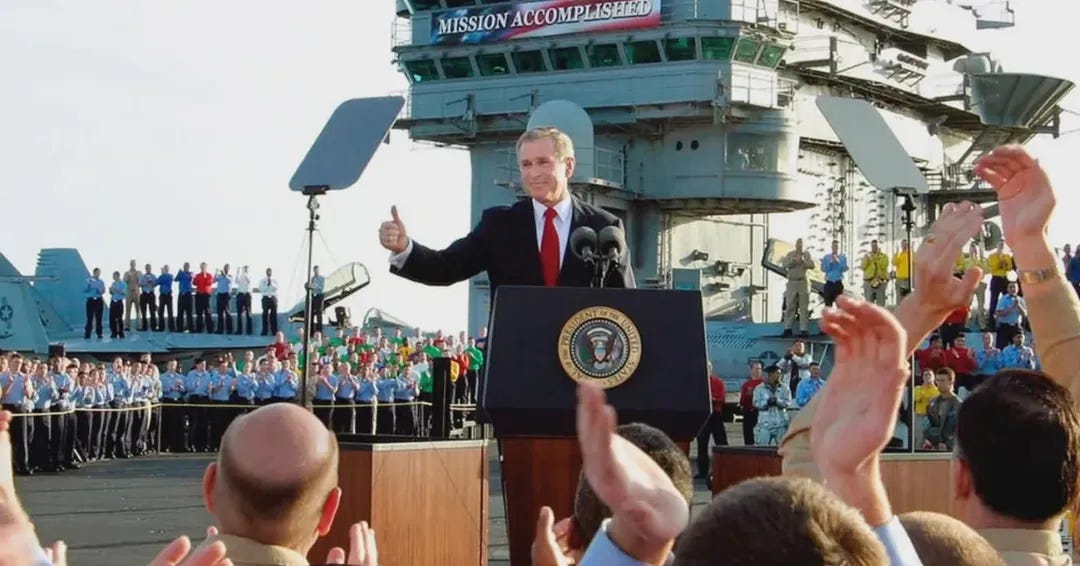
Note: Soon after this interview, Donald Trump would say in a news conference, “Let me say, we’ve won. You never like to say too early you won: We won. We won the bet — in the first hour, it was over.”
Source: It feels like being led by the blind. And they don’t seem to care. We’re gonna cause so much damage both to ourselves and to the people who live there. This incredible, unfathomable sum of money that’s been allocated to this. Use these incredibly expensive munitions that we’re burning through. And destabilize the entire world. I mean, it’s not even just [SWANA]2 now. We’re destabilizing the whole world. We’re raising energy costs in a way that we may never recover from. There’s no light at the end of the tunnel. We’re depleting our oil reserves. And someone has to pay for it and we’re gonna be paying for it for the next hundred years. It’s just... it really, to be honest, it feels catastrophic.
Why They Talked
Left Face Report: Knowing the risks, why did you decide to talk about this?
Source: I’m concerned. I’m damn near certain that this is going to be something that my children have to deal with. Maybe even their children.
This is, to me, one of the rhyming beats of history. We supply the Mujaheddin against the Soviet Union. And then ten years later, we’re fighting the Taliban. We replace the democratically elected leader of Iran and install the Shah. And now we’ve killed the Ayatollah. Any number of things where our interference creates generational conflict that never seems to end.
I’m concerned about this because I think that it demonstrates an incredible blindness to history. A willful blindness to history. And I think that people... myself, my comrades, my family. The American people at large and the people of Iran. I think that everyone’s going to pay the price. And it’s something that I think people should have an awareness of.
Complicit in Terror
Being someone who seems to understand the tragedy of war, I asked the source how they felt serving in the military of a country that repeatedly uses military force to make the world worse. What would he say to leftists who rightfully see anyone in uniform as complicit in executing the U.S.’s imperialist mission? (I do acknowledge, however, that I ask this from the retired comfort of not having to make those decisions anymore.)
Source: Even in the best, most leftist, most equitable, most peaceful version of the United States, the U.S. still has a military. I don’t think the country can survive without a military. So I don’t think that there’s an inherent wrong in being a part of the military, especially in an all-volunteer force where the fact that volunteers exist is why we don’t have compulsory service.
But the U.S. military has become an instrument for evil. So it’s kind of like the knife that’s stabbing me versus the knife that’s slicing my bread.
I do think good people should be in the military. Someone’s got to bear witness. Someone has to say no. If otherwise normal people didn’t join, you’d only ever have the Nazis willing to do any war crime asked of them. That’s the military Donald Trump and Pete Hegseth are trying to cultivate now.
In the U.S. capitalist top-down economy... and this is probably by design... for people who don’t have a college degree, don’t have resources... you’re choosing between working minimum wage or at a very low wage and not having healthcare and not being able to go to college and basically struggling your entire life. Or you have these narrow opportunities like joining the military where you can actually have a life. And that’s me. I’m not sure what I’d be doing if I didn’t join. Maybe I’d still be working at Home Depot. Maybe I wouldn’t be able to provide for my family. Maybe I wouldn’t be finishing my degree right now.
It Just Sucks
Left Face Report: Is there anything I haven’t asked that you think matters?
Source: I think we covered it. There’s a lot of uncertainty. A lot of people are waiting to see what happens in the midterms because there’s a very good chance that all of this changes again.
It just sucks. [pause] The people that are supposed to save you are incompetent.
Editor’s note:
This interview represents one person’s account from inside one unit. It is not the complete picture. The military is vast and no single source can speak for every service member in every branch facing this situation.
But one person with direct knowledge, speaking at personal risk, telling you that qualification standards are being gutted by directive, that morale is fracturing, that leadership was blindsided by their own orders, and that the people tasked with executing this potential operation don’t know if they’re sitting in Kuwait or seizing the Strait of Hormuz. That is not nothing.
The administration says the military is ready. This source says the military is being told to be ready. Those are different things. And the distance between them, over the next six months to a year, is where civilian casualties happen. Where friendly fire happens. Where the people who were rushed through a gutted training pipeline pay the price for decisions made by people who will never have to live with the consequences.
If you are a service member or veteran with information relevant to this reporting, you can reach me securely through the contact methods listed on the Left Face Report. Anonymity guaranteed.
SCIF - Sensitive Compartmented Information Facility
SWANA - Southwest Asia and North Africa